The grey zones of accessibility: when pass and fail stop being obvious
Four hours, live online, with two breaks. For people who already know the criteria — this session is about the cases where they stop giving a clean answer: captions that are almost right, security that locks people out, and the success criteria where two careful auditors reach different verdicts.
- 15:30–19:30 CET
- 06:30–10:30 PST
- 20:00–00:00 IST
- Pass or fail at the margin: caption accuracy, alt text that exists but says nothing, contrast on gradients and images — how to make the call and how to record it.
- Security versus accessibility: CAPTCHAs, session timeouts, one-time codes, blocked paste — and what Accessible Authentication (3.3.8) and Timing Adjustable (2.2.1) actually allow.
- The criteria auditors disagree on most — Info and Relationships (1.3.1), Name, Role, Value (4.1.2), Label in Name (2.5.3), Content on Hover or Focus (1.4.13) — with real examples and the reasoning behind each verdict.
- Third-party components you cannot change, and how "Partially Supports" in a VPAT should be worded so it stays honest.
Early bird 60 days left — price rises to $139 after.
Booking 3+ from one team? Get in touch for seats.
The criteria are clear. The cases are not.
WCAG reads as if every success criterion had a clean pass and a clean fail. In practice the hard part of an audit is the cases in between. WCAG gives no accuracy percentage for captions — so is a 99% accurate caption track a pass? What if the 1% is a drug dose, a name or a safety warning?
The same tension runs through security. Teams add CAPTCHAs, short timeouts, one-time codes and paste blocking for good reasons, and each one can shut a disabled user out. We look at where the line between security and accessibility actually sits, which mechanisms WCAG 2.2 allows, and the alternatives that remove the conflict instead of picking a loser.
Then we work through the criteria where experienced auditors most often disagree, case by case, and practise writing a verdict that holds up — to a developer, to a second auditor and, if it comes to it, to a lawyer. This is not an introduction: come knowing the A and AA criteria.
If you would rather the audit was simply done for you, that is the other half of what I do: accessibility audits on your own product, quoted at a fixed price within 48 hours.
Questions we argue through.
None of these has a one-line answer. We work through each with real examples — bring your own hard cases too.
- 01
Captions are 99% accurate — is Captions (Prerecorded) a pass or a fail? And what if the 1% is a name, a number or a warning?
- 02
Auto-generated captions on live content: what does Captions (Live) expect, and what is realistic?
- 03
Where is the line between security and accessibility — who decides, and how is the trade-off documented?
- 04
Do we need a CAPTCHA at all? If we do, which kinds pass Accessible Authentication, and which alternatives — honeypots, rate limiting, risk scoring — remove the need?
- 05
Session timeouts and one-time code expiry: how long is long enough, and when does the security exception in Timing Adjustable really apply?
- 06
Blocking paste in password and code fields — is it still defensible anywhere?
- 07
The alt text is there but useless. Does Non-text Content pass?
- 08
A custom component has the right name but the wrong role — a 4.1.2 fail, or just poor practice?
- 09
The visible label says "Search" and the accessible name says "Find" — where does Label in Name draw the line?
- 10
Contrast on gradients, background images and hover states: which pixel do you measure?
- 11
Third-party widgets you cannot change — chat, payments, maps: whose failure is it, and how does it go in the report?
- 12
"Partially Supports" in a VPAT: how much failure can it cover before it becomes "Does Not Support"?
Save your seat — before someone else does.
You'll get the Stripe receipt and a calendar invite straight away, and the Zoom link the day before. Early-bird pricing ends in 60 days.
Secure card payment via Stripe.
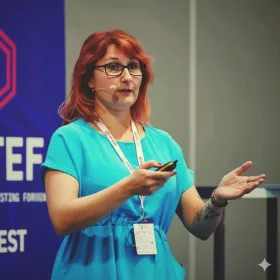
The person who'll also answer the email.
Imola
Software-testing practitioner and quality advocate with fifteen years in the field — across product teams, agencies and in-house QA orgs.
Today Imola runs Pearly Quality from Hungary: the workshops, the monthly letter, and the podcast.